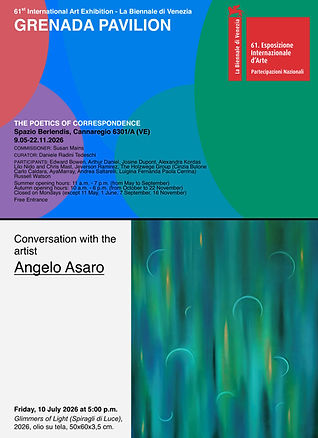
Welcome. We are here inside the Grenada Pavilion, curated by art critic Daniele Radini Tedeschi, on the occasion of the 61st Venice Biennale of Art. Joining us today is the artist Angelo Asaro, whom we warmly welcome for the presentation of his work Glimmers of Light (Spiragli di Luce).
It is an honour to be here to present one of the most recent developments in Asaro’s artistic production. Precisely because of the novelty and the unprecedented value of this work, I would like to briefly introduce the artist’s biography and outline some key elements of his research, in order to understand how he arrives at this most recent form of figuration.
Angelo Asaro was born and raised in Sicily, before moving abroad and developing a fully established artistic practice beyond the Italian borders, particularly in London. Before dedicating himself to figurative art and, more recently, to abstract research, he undertook significant studies in engineering.
These three aspects constitute some of the fundamental elements of his artistic research and practice. On one hand, Asaro’s work revolves around the themes of identity, memory, and remembrance, going on to explore not only, on an intimate level, the individual’s relationship with roots and origins, but also a broader cosmopolitan dimension, represented by the new city, as in the case of London.
To these elements are added contemporary relational themes: the relationship between the individual and society, but also with a global identity, with the act of mirroring oneself in others, and with the search for a sense of self that is built over time through contact and relationships with others.
His engineering studies, instead, provide him with a working method and an approach that, contrary to what is often assumed, is not purely instinctive or gestural — or at least not exclusively so — because his painting is characterised by a rigorous methodology in the construction of the image: in the choice of compositional structure, symbols, the symbolic value of colour, and the subjects represented.
Asaro began as a figurative artist, and more specifically as a Surrealist. However, he carefully avoids identifying himself with canonical Surrealism, such as that of Dalí. Rather, he defines his artistic practice as “noetic Surrealism”.
What does this mean? The Surreal is the presentation of a scenario in which realistic and recognisable elements are combined within a dimension where something impossible and irrational occurs — something, precisely, surreal. Whether this Surreal dimension is expressed through an atomic explosion, as in the case of Dalí, or through magical realism, as in the work of many South American artists, or even through religious mysticism, is of little importance.
What does Asaro do instead? His Surrealism originates from consciousness and thought, from the ability to methodically organise symbolic elements that, within reality, transcend it while simultaneously revealing and narrating it.
For this reason, his work is not inspired by dreams, automatic writing, or the automatism of the unconscious. It is always a process — not entirely controlled, I would say, but certainly guided and supervised by thought.
At a certain point, however, this structure and this highly methodical research begin to leave considerable space for colour, moving towards a form of liberation. In the more recent stages of his work, Asaro begins to draw inspiration from natural elements, such as the wings of a butterfly, focusing on the qualities of colour: its sensations and its vibrations.
This leads us to one of his most recent experiments, a true process of exploration, in which structure, while still present, progressively gives greater space to colour. From figurative painting, therefore, Asaro moves towards an experimentation with what we could define as abstract painting, presented here precisely on the occasion of this exhibition at the Grenada Pavilion.
Let us now focus on this canvas. We are faced not so much with a defined structure, but rather with fields of colour that become, at the same time, beams of light.
The title Spiragli di Luce (Glimmers of Light) helps us identify a strongly spiritual dimension of light, because abstraction, already beginning with Kandinsky, seeks correspondences between ethereal and immaterial elements. In Kandinsky’s case, these correspondences were connected to music: each colour was associated with a symbol and a musical note.
In this case, however, the colours, in my view, have the purpose of creating impressions, almost in the manner of Monet’s impressions of light: not a real light, but a profoundly inner light.
We therefore encounter a strong verticality: colours moving from black to blue, light blue, and green, together with these beams of light, these luminous openings emerging as if from distant and remote dimensions. In my view, however, they do not speak only of the spiritual light present within each of us, but rather of that relationship between the individual and an expanded reality that constantly returns throughout Asaro’s work. Here, however, it becomes a shared spiritual dimension, one that each of us crosses and experiences through our own individual openings of light.
I would like to conclude by emphasising the double title given by Asaro to this work. Spiragli di Luce, in Italian, perfectly conveys the poetic meaning that the artist seeks to express in representing an impossible world: an inner and universal light.
The English version, Glimmers, does not indicate precisely an opening or a ray of light, but rather a faint glimpse or a glimmer of light. For this reason, the canvas enters into dialogue with the concept of light throughout the history of painting and thought.
Light has also been studied from a scientific perspective by Newton, whose conception of light profoundly influenced modern thought, particularly from the age of Positivism onwards. Goethe, the German Romantic writer and thinker, also devoted himself to the theory of colour, in an approach that, in my view, is much closer to Asaro’s sensitivity.
Goethe interpreted colour through its vibrations, considering pictorial colour not only from a scientific perspective, but above all through a humanistic, artistic, emotional, and spiritual dimension. And this, in my view, represents the most profound value of Asaro’s work.
VENICE BIENNALE 2026
GRENADA PAVILION
Critical presentation curated by
Dr. Valentina Minniti